

Dear Wikipedians,
“We are still far from having collected the sum of all knowledge. Most of the content we have created is in the form of long-form encyclopedia articles and still images, which leaves out many other types of knowledge.” [1]
The world we live in, from the smallest molecules to the vastness of the solar system and galaxies, is three-dimensional. We perceive the world in 3D, and we are naturally attracted to representations that mirror this perceptual richness.
As humans, our primary source of knowledge is perception and our senses play a fundamental role in how we understand and capture the information around us, shaping our comprehension not just through sight and sound, but also through touch, taste, and smell. The evolution of digital technologies has made it possible to capture, reproduce, copy, or build objects from the external world. Knowledge can be derived from these various types of representations which can take the form of printed text, images, videos, audio, 3D models, structured data, etc.
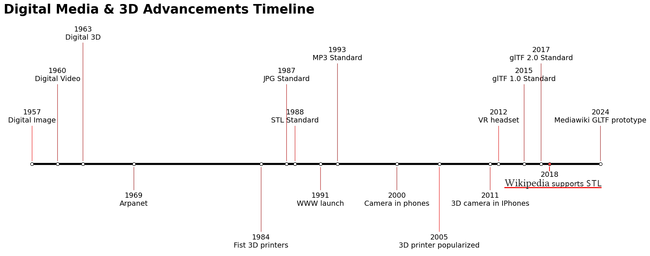
3D in Wikipedia
The need for a 3D strategy to integrate three-dimensional content was identified in 2015 [2] and in Community Wishlist Survey in 2016 [3] by members of the community, but today Wikipedia still lacks such a strategy, and 3D content remains underdeveloped.
Uploading 3D models to Wikimedia Commons became publicly available on 20 February 2018 [4].
This feature was limited to just STL format, used mainly for 3D printing, as this blog post stated:
"The new 3D upload feature will initially only support the .STL file format, the format most commonly used by 3D printers. These 3D files will show a static preview image when viewing, and an interactive viewer will load when that preview image is clicked. In the future, after feedback from our community of volunteer editors, we’ll consider adding support for even more complex file types that support features like textures."
STL was a time-tested and established standard, but presented technical limitations compared to other 3D file formats like glTF that could handle textures, colors, animations, and optimized file size.
Since then, the lack of a 3D strategy and the technical limitations of the STL format hindered the repository's ability to serve as a true home for freely licensed 3D content, which represented a missed opportunity to host digital assets from countless sources, such as individual creators, cultural institutions (GLAM), open-source communities, educational initiatives, and public and private organizations. Nowadays, community members are forced to use suboptimal solutions like animated GIFs to showcase processes such as the functioning of the heart. Heart 3D model (Picture of the year 2017 3rd place), Clavicle or a Sneakers.


At a time when museums, cultural institutions, and heritage organizations with openly licensed content are eager to share their extensive digital collections, this lack of better 3D support in Commons is a significant barrier.
3D usage inside Wikipedia and Commons never took off. At the time of writing, Wikimedia Commons has 115 million files, of which just 10,261 (0.00831%) are 3D models [5].
Meanwhile, commercial 3D marketplaces that emerged in the 2010s capitalized on this opportunity, successfully growing their content libraries and attracting millions of users.
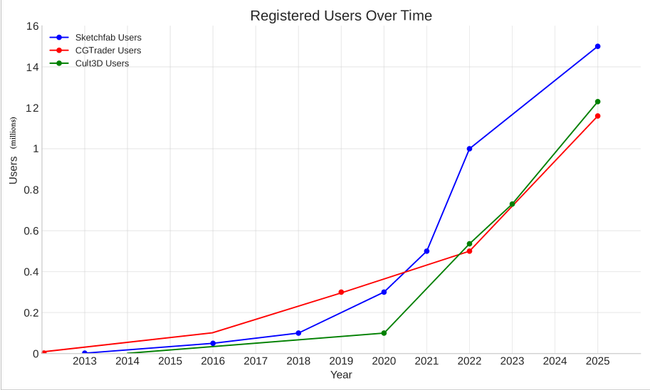

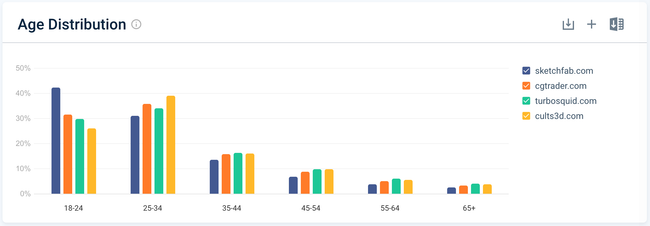
Creators and users aged 18–34, a demographic underrepresented in Wikipedia’s editor base but dominant in 3D platforms.
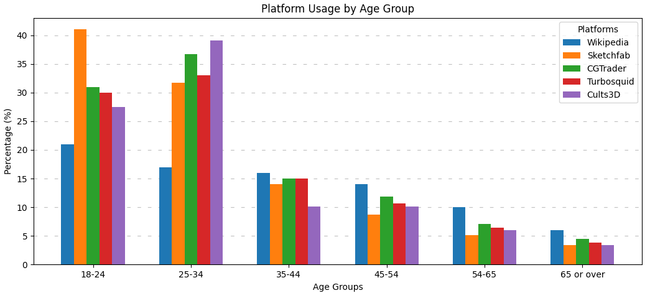
The urgent need for a free licensed 3D platform.
In 2014, Sketchfab announced CC licensing and in 2020 launched a public domain dedication program for 3D cultural heritage. This collaboration started with 27 cultural organisations from 13 different countries and allowed them to implement open access policies by sharing their 3D data under CC0 licenses and enabled everyone to download and reuse this content. During almost a decade, Sketchfab has been a widely used platform for hosting and sharing 3D cultural heritage content.
The 3D market has been consolidating since 2021. Turbosquid was acquired by Shutterstock, and Epic Games Inc. acquired Sketchfab, which began migrating its assets around 2024, before announcing its own 3D marketplace, Fab.com. This decision by Epic Games Inc. sent ripples through the community, and the transition raised concerns within the cultural heritage community about the potential loss of years of work and thousands of 3D models, highlighting the risks of relying on commercial solutions for preservation and dissemination.
The resulting uncertainty has led to public concern and a collective call for platforms that safeguard open access.
A public petition demanding Sketchfab's continuity and independence garnered widespread support, and the community is closely following the process, reflecting a growing fear: without a robust, open repository for 3D content, humanity risks losing access to critical digital heritage.
Community Momentum
Although progress on improving 3D support has largely stalled since the announcement of STL support in 2018, the community has continued discussing and giving feedback. [7] [8] [9] and in the last 2-3 years, there has been a growing interest and a community drive to carry out this work.
Growing Advocacy: A dedicated 3D Wikipedia Community Group [10] has formed, including experts from the Khronos Group (creators of glTF), IIIF, Sketchfab employees, cultural institutions, and many other volunteers. Its members have engaged in advocacy activities such as the Commons Community Meetings, Wikimania 2023 and 2025, 3D Wikipedia group meetings, etc.
Technical Progress: A functional prototype for glTF support [12] has been developed in collaboration between volunteers and WMF employees, and over 100,000 freely licensed 3D models, downloaded from Sketchfab, are ready to be incorporated into Commons. A curated list of sources for freely licensed 3D assets, including public institutions, open-source communities, private organizations, etc. is being developed.
Strategic Alignment: The 2024 Community Wishlist’s top-ranked proposal focuses on improving 3D support, reflecting strong volunteer consensus. [11]
Community demand
Strategic Prioritization of 3D
Incorporate 3D into the upcoming annual planning and 2026–2030 strategy cycle, securing the necessary resources to make Wikipedia truly 3D.
Establish a 3D Working Group
The creation of a working group to design, plan, and implement a 3D strategy for Wikipedia. This working group should incorporate previous community efforts, expertise, and the people behind them. Wikimedia Foundation should evaluate the right way to do this and we identify the Product and Technology Advisory Council as a helpful organizational instrument.
Enhanced 3D User Experience
Improve the 3D media experience when uploading, viewing, downloading, and sharing 3D models.
Viewer. A state-of-the-art 3D viewer that supports basic functionality and advanced features.
Renderer. An updated and efficient 3D image renderer to generate thumbnails of the 3D assets.
Formats. Wider compatibility with 3D standards and modern file formats such as glTF.
Stakeholders
Promote the initiative among collaborators, communities, and institutions that already participate in Wikipedia and amplify outreach to include new ones outside Wikipedia. Some of them may include GLAM-Wiki, Wiki Loves Monuments, Common European data space for cultural heritage, Europeana Pro, Europa Nostra, etc.
Wikipedia’s Opportunity: A Call to Lead
As Wikipedia approaches its 25th anniversary in 2026, the Wikimedia Foundation has described this milestone as a generational moment for reflection and renewal. The 2025–2026 Annual Plan emphasizes the importance of adapting to a rapidly changing internet, shaped by artificial intelligence, immersive media, and evolving patterns of participation. In this context, strengthening support for 3D content aligns directly with the Foundation’s stated priorities.
It also highlights the need to “shape a changing internet” by bringing encyclopedic knowledge into formats that meet audiences where they are. Younger generations are increasingly active in gaming, social platforms, and 3D creative spaces, yet they remain underrepresented in the Wikipedia editor community. By integrating 3D into the Wikimedia ecosystem, the movement can open new entry points for contribution, attract younger demographics, and expand participation in line with the goal of fueling volunteer growth.
Nearly half of the Foundation’s annual budget is dedicated to technology and infrastructure, with explicit commitments to experiment with new formats and improve user experiences. A modern, standards-based 3D framework fits within this mandate, just as previous investments expanded support for video, audio, and data visualization.
The Annual Plan also reinforces knowledge equity and cultural preservation as strategic imperatives. Many institutions worldwide — museums, archives, universities, and open-source communities — are producing open 3D assets. Wikipedia is uniquely positioned to provide a stable, nonprofit platform to host this content, ensuring long-term accessibility and aligning with the mission to safeguard free knowledge for generations to come.
Finally, the Foundation is piloting new models of collaborative governance, such as the Product and Technology Advisory Council. A 3D working group, modeled on these initiatives, could provide the structure needed to coordinate community expertise, institutional partnerships, and Foundation resources.
By integrating 3D into its strategic vision, Wikipedia can not only respond to emerging global trends but also extend its leadership role as the essential infrastructure of free knowledge in a changing digital landscape.
References
1. Strategy - Direction. https://meta.wikimedia.org/wiki/Strategy/Wikimedia_movement/2017/Direction
2. User:Theredmonkey/Why we are lacking a 3D strategy.
3. Community Wishlist Survey 2016. https://meta.wikimedia.org/wiki/Community_Wishlist_Survey_2016/Categories/Multimedia#3D_models
4. You can now upload 3D models to Wikimedia Commons https://wikimediafoundation.org/news/2018/02/20/three-dimensional-models/
5. Media statistics (27 July 2025). https://commons.wikimedia.org/wiki/Special:MediaStatistics
6. Sketchfab Celebrates 10 Million Members. https://sketchfab.com/blogs/community/sketchfab-celebrates-10-million-members/
7. Support full color 3D models on Wikimedia projects https://phabricator.wikimedia.org/T246901
8. Support the glTF 2.0 3D file format. https://phabricator.wikimedia.org/T187844
9. Commons:Village pump/Proposals. https://commons.wikimedia.org/wiki/Commons:Village_pump/Proposals/Archive/2023/09#Enable_textured_3D_files_on_Commons
10. Telegram 3D on Wikipedia and Commons. https://meta.wikimedia.org/wiki/Telegram#Wikimedia_Commons
11. Community Wishlist / Focus Areas. https://meta.wikimedia.org/wiki/Special:MyLanguage/Community_Wishlist/Focus_areas
12. Wikipedia 3D colored viewer prototype. https://en.wikipedia.org/wiki/File:Wikipedia_3D_prototype.webm
13. Commons:Textured 3D. https://commons.wikimedia.org/wiki/Commons:Textured_3D
Total number users of Wikipedia and 3d marketplaces.
User demographics of Wikipedia and 3D marketplaces.
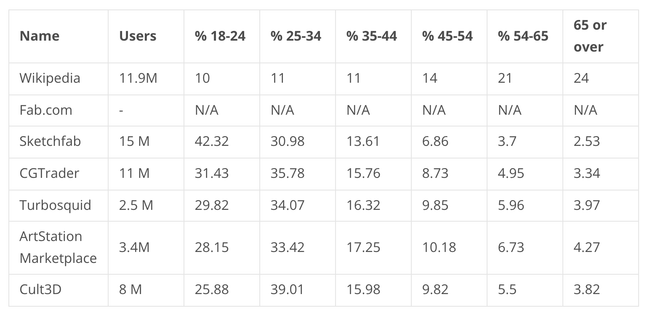
Sketchfab, Turbosquid, CGTrader and Cults3D. https://www.similarweb.com/
Content

Sketchfab. https://sketchfab.com/about
Cults 3D. https://cults3d.com/en/cults
CGTrader. https://www.cgtrader.com/about-us
Turbosquid. https://www.turbosquid.com/Search/3D-Models
Do you like what you are reading? Subscribe to receive updates.
Unsubscribe anytime